Twenty years of temperate montane forest progression in the oldest Polish national park
DOI:
https://doi.org/10.15287/afr.2025.4070Keywords:
Abies alba, aboveground biomass, Fagus sylvatica, increment, monitoring, mortality, recruitmentAbstract
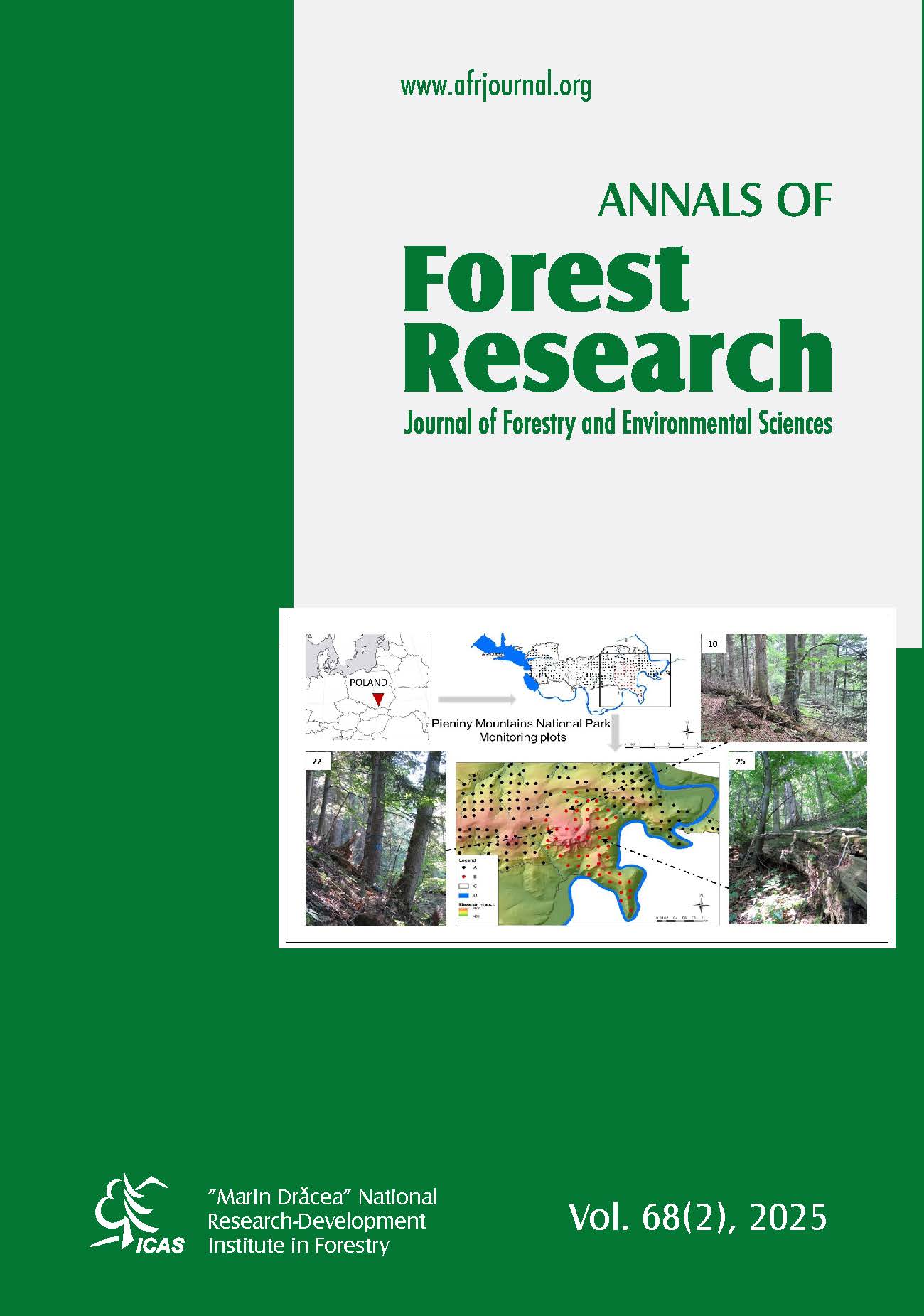
The historical fragmentation of forest ecosystems led to a significant spatial reduction in natural forest biomes. After centuries of exploitation for various purposes, the fragments remaining as national parks have been systematically monitored. This provides a wide range of field data and allows an in-depth understanding of processes responsible for short- and long-term forest dynamics. The existing monitoring systems should be considered unique and worth maintaining because they spanned before the era of remote sensing data acquisition in sufficient spatial and temporal resolution. We explored tree monitoring data from the oldest national park in Poland – Pieniny National Park (PNP) in the Western Carpathians, established in 1932. We assessed stand aboveground increment, recruitment, and mortality for 44 monitoring plots with field observations obtained in 1987, 1998, and 2009. Using a linear mixed-effects model, we assessed differences in stand biomass among sampling years and determined the drivers of biomass dynamics. For relative values of increment, recruitment, and mortality, we developed generalized linear mixed-effects models with a Beta distribution of the dependent variable. We found that stand composition was only slightly affected across 22 years. The mean aboveground biomass increased evenly and significantly (from 168 to 237 Mg/ha). Stand dynamics were mostly affected by stand structure characteristics, especially basal area (BA) and density, while other factors (geomorphometric and climatic characteristics) modified these relationships. The importance of climatic and geomorphometric factors shows local responses of stand dynamics, which can be utilized for fine-scale sites. We found twice higher relative increments in SW than in NE exposition, which can be related to higher insolation (sunlight and temperature) on SW-exposed hillslopes. The aboveground tree biomass change caused by mortality was partly controlled by several variables, among which the most important was BA. With increasing BA, mortality increased and was also slightly related to steeper slopes. Species-specific trends were dominated by species proportion. Fagus sylvatica had higher relative increment and mortality in plots with its dominance, while Abies alba absolute increment decreased. Studying the mountain forest dynamics is crucial for biodiversity, soil and groundwater protection, and tourism. Ground measurements are an accurate way to estimate biomass.
References
Alberti G., Candido P., Peressotti A., et al., 2005. Aboveground biomass relationships for mixed ash (Fraxinus excelsior L. and Ulmus glabra Hudson) stands in Eastern Prealps of Friuli Venezia Giulia (Italy). Annals of Forest Science 62: 831–836. https://doi.org/10.1051/forest:2005089
Allen II M., Brunner A., Antón-Fernández C., Astrup R., 2021. The relationship between volume inreament and stand density in Norway spruce plantations. Forestry 94: 151–165. https://doi.org/10.1093/forestry/cpaa020
Anselmetti F.S., Hodell D.A., Ariztegui D., et al., 2007. Quantification of soil erosion rates related to ancient Maya deforestation. Geology 35: 915–918. https://doi.org/10.1130/G23834A.1
Bao Y., Liu X., Feng C.-H., et al., 2024. Light and light signals regulate growth and development in woody plants. Forests 15: 523. https://doi.org/10.3390/f15030523
Bartoń K., 2017. MuMln: Multi-Model Inference. https://cran.r-project.org/web/packages/MuMIn/index.html
Bebi P., Seidl R., Motta R., et al., 2017. Changes of forest cover and disturbance regimes in the mountain forests of the Alps. Forest Ecology and Management 388: 43–56. https://doi.org/10.1016/j.foreco.2016.10.028
Beers T.W., Dress P.E., Wensel L.C., 1966. Notes and Observations: Aspect Transformation in Site Productivity Research. Journal of Forestry 64: 691–692. https://doi.org/10.1093/jof/64.10.691
Birkeland P.W., Shroba R.R., Burns S.F., et al., 2003. Integrating soils and geomorphology in mountains - an example from the Front Range of Colorado. Geomorphology 55: 329–344. https://doi.org/10.1016/S0169-555X(03)00148-X
Birkenmajer K., 2017. Geology of the Pieniny Mountains, West Carpathians, Poland (in Polish, with English Summary). Monografie Pienińskie 3: 5–66.
Bodziarczyk J., Pancer-Kotejowa E., Różański W., 2016. Forest vegetation of the Pieniny National Park based on the systematic-random sampling (in Polish, with English summary). Pieniny - Przyroda i Człowiek 14: 17–50.
Böhner J., Selige T., 2006. Spatial prediction of soil attributes using terrain analysis and climate regionalisation. In: Boehner, J., McCloy, K.R., Strobl, J.: SAGA – Analysis and Modelling Applications, Goettinger Geographische Abhandlungen 115: 13-27.
Bonannella C., Parente L., de Bruin S., Herold M., 2024. Multi-decadal trend analysis and forest disturbance assessment of European tree species: concerning signs of a subtle shift. Forest Ecology and Management 554: 121652. https://doi.org/10.1016/j.foreco.2023.121652
Bond G., Kromer B., Beer J., et al., 2001. Persistent Solar Influence on North Atlantic Climate During the Holocene. Science 294: 2130–2136. https://doi.org/10.1126/science.1065680
Brooks M.E., Kristensen K., Benthem K.J. van, et al., 2017. glmmTMB Balances Speed and Flexibility Among Packages for Zero-inflated Generalized Linear Mixed Modeling. The R Journal 9(2): 378, 10.32614/RJ-2017-066
Carvalho T.S., Domingues E.P., Horridge J.M., 2017. Controlling deforestation in the Brazilian Amazon: Regional economic impacts and land-use change. Land Use Policy 64: 327–341. https://doi.org/10.1016/j.landusepol.2017.03.001
Cazzolla Gatti R., Callaghan T., Velichevskaya A., et al., 2019. Accelerating upward treeline shift in the Altai Mountains under last-century climate change. Scientific Reports 9: 1–13. https://doi.org/10.1038/s41598-019-44188-1
Conrad O., Bechtel B., Bock M., et al., 2015. System for Automated Geoscientific Analyses (SAGA) v. 2.1.4. Geoscientific Model Development 8: 1991–2007. https://doi.org/10.5194/gmd-8-1991-2015
Conradi T., Eggli U., Kreft H., et al., 2024. Reassessment of the risks of climate change for terrestrial ecosystems. Nature Ecology & Evolution. https://doi.org/10.1038/s41559-024-02333-8
Coogan S.C.P., Robinne F.-N., Jain P., Flannigan M.D., 2019. Scientists’ warning on wildfire - a Canadian perspective. Canadian Journal of Forest Research 49: 1015–1023. https://doi.org/dx.doi.org/10.1139/cjfr-2019-0094
Desmet P.J.J., Govers G., 1996. A GIS procedure for automatically calculating the USLE LS factor on topographically complex landscape units. Journal of Soil and Water Conservation 51: 427–433.
Dyderski M.K., Pawlik Ł., 2020. Spatial distribution of tree species in mountain national parks depends on geomorphology and climate. Forest Ecology and Management 474: 118366. https://doi.org/10.1016/j.foreco.2020.118366
Dyderski M.K., Pawlik Ł., 2021. Drivers of forest aboveground biomass and its increments in the Tatra Mountains after 15 years. Catena 205: 105468. https://doi.org/10.1016/j.catena.2021.105468
Dyderski M.K., Pawlik Ł., Chwistek K., Czarnota P., 2023, Tree aboveground biomass increment and mortality in temperate mountain forests: Tracing dynamic changes along 25-year monitoring period. Forest Ecology and Management 540: 121054. https://doi.org/10.1016/j.foreco.2023.121054
Dyderski M.K., Paź-Dyderska S., Jagodziński A.M., Puchałka R., 2025. Shifts in native tree species distributions in Europe under climate change. Journal of Environmental Management 373: 123504. https://doi.org/10.1016/j.jenvman.2024.123504
Dziewolski J., 1980. The changes in the structure and resources of the forest of the strict reserve in the Trzy Korony massif of the Pieniny mountain range in the period 1936-1972 (In Polish, with English summary). Ochrona Przyrody 43: 129–156.
Dziewolski J., 1992. Development and changes in the Pieniny National Park in the period 1936-1972 (in Polish, with English summary). Pieniny - Przyroda i Człowiek 1: 41–52.
Forrester D.I., Bauhus J., 2016. A Review of Processes Behind Diversity - Productivity Relationships in Forests. Current Forestry Reports 2: 45–61. https://doi.org/10.1007/s40725-016-0031-2
Forrester D.I., Tachauer I.H.H., Annighoefer P., et al., 2017. Generalized biomass and leaf area allometric equations for European tree species incorporating stand structure, tree age and climate. Forest Ecology and Management 396: 160–175. https://doi.org/10.1016/j.foreco.2017.04.011
Fuentes M., Niklasson M., Drobyshev I., Karlsson M., 2010. Tree mortality in a semi-natural beech forest in SW Sweden. Ecological Bulletins 53: 117–129.
Guisan A., Weiss S.B., Weiss A.D., 1999. GLM versus CCA spatial modeling of plant species distribution. Plant Ecology 143: 107–122.
GUGiK, 2022. Digital Elevation Model, https://www.geoportal.gov.pl/en/data/digital-elevation-model-dem/
Hanewinkel M., Cullmann D.A., Schelhaas M.-J., et al., 2013 Climate change may cause severe loss in the economic value of European forest land. Nature Climate Change 3: 203–207. https://doi.org/10.1038/NCLIMATE1687
Hansen M.C., Potapov P.V., Moore R., et al., 2013. High resolution global maps of 21st-century forest cover change. Science 342: 850–853. https://doi.org/10.1126/science.1244693
Hartl-Meier C., Zang C., Dittmar C., et al., 2014. Vulnerability of Norway spruce to climate change in mountain forests of the European Alps. Climate Research 60: 119–132. https://doi.org/10.3354/cr01226
Hijmans R., 2023. terra: Spatial Data Analysis. R package version 1.7-1.8.
Hilmers T., Avdagić A., Bartkowicz L., et al., 2019. The productivity of mixed mountain forests comprised of Fagus sylvatica, Picea abies, and Abies alba across Europe. Forestry: An International Journal of Forest Research 92: 512–522. https://doi.org/10.1093/forestry/cpz035
Hlásny T., Barcza Z., Fabrika M., et al., 2011. Climate change impacts on growth and carbon balance of forests in Central Europe. Climate Research 47: 219–236. https://doi.org/10.3354/cr01024
Idoate-Lacasia J., Stillhard J., Portier J., et al., 2024. Long-term biomass dynamics of temperate forests in Europe after cessation of management. Forest Ecology and Management 554: 121697. https://doi.org/10.1016/j.foreco.2024.121697
IMWM – NRI, 2023. Climate of Poland. https://klimat.imgw.pl
Jagodziński A.M., Dyderski M.K., Gęsikiewicz K., Horodecki P., 2018. Tree- and Stand-Level Biomass Estimation in a Larix decidua Mill. Chronosequence. Forests 9: 587. https://doi.org/10.3390/f9100587
Jagodziński A.M., Dyderski M.K., Gęsikiewicz K., Horodecki P., 2019. Tree and stand level estimations of Abies alba Mill. aboveground biomass. Annals of Forest Science 76: 56. https://doi.org/10.1007/s13595-019-0842-y
Jagodziński A.M., Dyderski M.K., Horodecki P., 2020. Differences in biomass production and carbon sequestration between highland and lowland stands of Picea abies (L.) H. Karst. and Fagus sylvatica L. Forest Ecology and Management 474: 118329. https://doi.org/10.1016/j.foreco.2020.118329
Janík D., Král K., Adam D., et al., 2016. Tree spatial patterns of Fagus sylvatica expansion over 37years. Forest Ecology and Management 375: 134–245. https://doi.org/10.1016/j.foreco.2016.05.017
Kabała C., 2018. Rendzina (rędzina) - soil of the year 2018 in Poland. Introduction to origin, classification and land use of rendzinas. Soil Science Annual 69: 63–74. https://doi.org/10.2478/ssa-2018-0007
Karger D.N., Conrad O., Böhner J., et al., 2017. Climatologies at high resolution for the Earth’s land surface areas. Scientific Data 4: 170122. https://doi.org/10.1038/sdata.2017.122
Karger D.N., Zimmermann N.E., 2018. CHELSAcruts - High resolution temperature and precipitation timeseries for the 20th century and beyond. EnviDat. https://www.doi.org/10.16904/envidat.159
Kulla L., Roessiger J., Bošeľa M., et al., 2023. Changing patterns of natural dynamics in old-growth European beech (Fagus sylvatica L.) forests can inspire forest management in Central Europe. Forest Ecology and Management 529: 120633. https://doi.org/10.1016/j.foreco.2022.120633
Kuznetsova A., Brockhoff, P.B., Christensen R.H.B., 2017. ImerTest: Tests in Linear Mixed Effects Models. Journal of Statistical Software 82, 13. http://dx.doi.org/10.18637/jss.v082.i13
Latałowa M., Zimny M., Jędrzejewska B., Samojlik T., 2015. Białowieża Primeval Forest: a 2000-year interplay of environmental and cultural forces in Europe’s best preserved temperate woodland. In: Europe’s changing woods and forests: from wildwood to managed landscapes. CABI, 243–264.
Latterini F., Pawlik Ł., Stefanoni W., Dyderski M.K., 2024. The effects of geomorphology, soil and climate on the trajectory of aboveground biomass accumulation of beech (Fagus sylvatica L.) at the southern range margin. Catena 237: 107787. https://doi.org/10.1016/j.catena.2023.107787
Lebourgeois F., Gomez N., Pinto P., Mérian P., 2013. Mixed stands reduce Abies alba tree-ring sensitivity to summer drought in the Vosges mountains, western Europe. Forest Ecology and Management 303: 61–71. https://doi.org/10.1016/j.foreco.2013.04.003
Lenth R., 2019. emmeans: Estimated Marginal Means, aka Least-Squares Means. https://CRAN.R-project.org/package=emmeans
Loarie S.R., Duffy P.B., Hamilton H., et al., 2009. The velocity of climate change. Nature 462: 1052–1055. https://doi.org/10.1038/nature08649
Lüdecke D., 2018. ggeffects: Tidy Data Frames of Marginal Effects from Regression Models. Journal of Open Source Software 3(26): 772. http://joss.theoj.org/papers/10.21105/joss.00772
Maclean I.M.D., Early R., 2023. Macroclimate data overestimate range shifts of plants in response to climate change. Nature Climate Change 13: 484–490. https://doi.org/10.1038/s41558-023-01650-3
Matsala M., Odruzhenko A., Hinchuk T., et al., 2024. War drives forest fire risks and highlights the need for more ecologically-sound forest management in post-war Ukraine. Scientific Reports 14. https://doi.org/10.1038/s41598-024-54811-5
Mazurski K.R., 1986, The destruction of forests in the Polish Sudetes Mountains by industrial emissions. Forest Ecology and Management 17: 303–315. https://doi.org/10.1016/0378-1127(86)90158-1
McDowell N., Allen C.D., Anderson-Teixeira K., et al., 2020. Pervasive shifts in forest dynamics in a changing world. Science 368(6494). doi:10.1126/science.aaz9463
Michalik S., 2005. Pieniny - park dwu narodów: przewodnik przyrodniczy. Pieniński Park Narodowy, Krościenko nad Dunajcem.
Nakagawa S., Schielzeth H., 2013. A general and simple method for obtaining R2 from generalized linear mixed-effects models. Methods in Ecology an Evolution 4(2): 133-142. http://onlinelibrary.wiley.com/doi/10.1111/j.2041-210x.2012.00261.x/abstract
Nascimento M.N., Aukes T.F.N., McMichael C.N.H., 2024. Indigenous and colonial influences on Amazonian forests. Plants People Planet. https://doi.org/10.1002/ppp3.10515
Niemyska-Łukaszuk J., Zaleski T., Miechówka A., 2004. Characteristics of the soils of the Pieniny National Park (in Polish, with English summary). Studia Naturae 49: 33–41.
Oksanen J., Blanchet F.G., Kindt R., et al., 2018. “vegan” 2.3.3. - Community Ecology R Package.
Orians G.H., Pheiffer E.W., 1970. Ecological Effects of the War in Vietnam. Science 168: 544–554. https://doi.org/10.1126/science.168.3931.544
Patacca, Lindner M., Lucas-Borja M.E., et al., 2023. Significant increase in natural disturbance impacts on European forests since 1950. Global Change Biology 29: 1354–1376. https://doi.org/10.1111/gcb.16531
Perzanowska J., 2004. Climate of the Pieniny Mountains (in Polish, with English summary). Studia Naturae 49: 21–32.
Pietrzykowski M., Woś B., 2021. The impact of climate change on forest tree species dieback and changes in their distribution. In: Climate Change and the Microbiome. Springer, Cham., pp 447–460.
Piovesan G., Di Filippo A., Alessandrini A., et al., 2005. Structure, dynamics and dendroecology of an old-growth Fagus forest in the Apennines. Journal of Vegetation Science 16: 13–28. https://doi.org/10.1111/j.1654-1103.2005.tb02334.x
Pretzsch H., 2009. Forest dynamics, growth, and yield. From Measurement to Model. Springer, Berlin.
Pretzsch H., 2020. Density and growth of forest stands revisited. Effect of the temporal scale of observation, site quality, and thinning. Forest Ecology and Management 460: 117879. https://doi.org/10.1016/j.foreco.2020.117879
R Core Team, 2023. R: A language and environment for statistical computing. R Foundation for Statistical Computing, Vienna, Austria. http://www.R-project.org/
Reich P.B., Oleksyn J., 2008. Climate warming will reduce growth and survival of Scots pine except in the far north. Ecology Letters 11: 588–597. https://doi.org/10.1111/j.1461-0248.2008.01172.x
Rice S., Stoffel M., Turowski J.M., Wolf A., 2012. Disturbance regimes at the interface of geomorphology and ecology. Earth Surface Processes and Landforms 37: 1678–1682. https://doi.org/10.1002/esp.3326
Riley S.J., DeGloria S.D., Elliot R., 1999. A Terrain Ruggedness Index that quantifies topographic heterogeneity. Intermountain Journal of Sciences 5: 23–27.
Rohner B., Bigler C., Wunder J., et al., 2012. Fifty years of natural succession in Swiss forest reserves: changes in stand structure and mortality rates of oak and beech. Journal of Vegetation Science 23: 982–905. https://doi.org/10.1111/j.1654-1103.2012.01408.x
Romeiro J.M.N., Eid T., Antón-Fernández C., et al., 2022. Natural disturbances risks in European Boreal and Temperate forests and their links to climate change - A review of modelling approaches. Forest Ecology and Management 509: 120071. https://doi.org/10.1016/j.foreco.2022.120071
Różański W., Bodziarczyk J., Pancer-Kotejowa E., 1994. Numerical Analysis of Forest Vegetation in Biomonitoring of the Pieniny National Park. Colloques Phytosociologiques 23: 657–670.
Šamonil P., Phillips J.D., Pawlik Ł., 2021. Indirect biogeomorphic and soil evolutionary effects of spruce bark beetle. Global and Planetary Change 195: 103317. https://doi.org/10.1016/j.gloplacha.2020.103317
Schelhaas M.-J., Nabuurs G.-J., Schuck A., 2003. Natural disturbances in the European forests in the 19th and 20th centuries. Global Change Biology 9: 1620–1633. https://doi.org/10.1046/j.1365-2486.2003.00684.x
Seidl R., Schelhaas M.-J., Rammer W., Verkerk P.J., 2014. Increasing forest disturbances in Europe and their impact on carbon storage. Nature Climate Change 4: 806–810. https://doi.org/10.1038/nclimate2318
Seidl R., Thom D., Kautz M., et al., 2017. Forest disturbances under climate change. Nature Climate Change 7. https://doi.org/10.1038/NCLIMATE3303
Senf C., Pflugmacher D., Zhiqiang Y., et al., 2018. Canopy mortality has doubled in Europe’s temperate forests over the last three decades. Nature Communications 9: 4978. https://doi.org/10.1038/s41467-018-07539-6
Senf C., Seidl R., 2021. Mapping the forest disturbance regimes of Europe. Nature Sustainability 4: 63–70. https://doi.org/10.1038/s41893-020-00609-y
Sørensen R., Seibert J., 2007. Effects of DEM resolution on the calculation of topographical indices: TWI and its components. Journal of Hydrology 347: 79–89. https://doi.org/10.1016/j.jhydrol.2007.09.001
Stage A.R., 1976. An expression of the effects of aspect, slope, and habitat type on tree growth. Forest Science 22: 457–460.
Steinbauer M.J., Grytnes J.-A., Jurasinski G., et al., 2018. Accelerated increase in plant species richness on mountain summits is linked to warming. Nature 556: 231–234. https://doi.org/10.1038/s41586-018-0005-6
Sun H., Diao S., Liu R., et al., 2018. Relationship between size inequality and stand productivity is modified by self-thinning, age, site and planting density in Sassafras tzumu plantations in central China. Forest Ecology and Management 422: 199–206. https://doi.org/10.1016/j.foreco.2018.02.003
Thom D., Seidl R., Steyrer G., et al., 2013. Slow and fast drivers of the natural disturbance regime in Central European forest ecosystems. Forest Ecology and Management 307: 293–302. http://dx.doi.org/10.1016/j.foreco.2013.07.017
Timár G., Molnár G., Székely B., et al., 2006. Digitized maps of the Habsburg Empire - the map sheets of the second military survey and their georeferenced version. Arcanum 59.
Tyszkiewicz J., 1992. Legal acts, meetings and celebrations connected with establishment of the National Park in the Pieniny Mountains (1929-1932) (in Polish, with English summary). Pieniny - Przyroda i Człowiek 1.
Vančura K., Šimková M., Vacek Z., et al., 2022. Effects of environmental factors and management on dynamics of mixed calcareous forests under climate change in Central European lowlands. Dendrobiology 87: 79–100. https://doi.org/10.12657/denbio.087.006
Waga J.M., Fajer M., Szypuła B., 2022. The scars of war: A programme for the identification of the environmental effects of World War II bombings for the purposes of spatial management in the Koźle Basin, Poland. Environmental & Socio-economic Studies 10: 57–67. https://doi.org/10.2478-environ-2022-0005
Zellweger F., Frenne P.D., Lenoir J., et al., 2020. Forest microclimate dynamics drive plant responses to warming. Science 368: 772–775. https://doi.org/10.1126/science.aba6880
Downloads
Published
Issue
Section
License
All the papers published in Annals of Forest Research are available under an open access policy (Gratis Gold Open Access Licence), which guaranty the free (of taxes) and unlimited access, for anyone, to entire content of the all published articles. The users are free to "read, copy, distribute, print, search or refers to the full text of these articles", as long they mention the source.
The other materials (texts, images, graphical elements presented on the Website) are protected by copyright.
The journal exerts a permanent quality check, based on an established protocol for publishing the manuscripts. The potential article to be published are evaluated (peer-review) by members of the Editorial Board or other collaborators with competences on the paper topics. The publishing of manuscript is free of charge, all the costs being supported by Forest Research and Management Institute.
More details about Open Access:
Wikipedia: http://en.wikipedia.org/wiki/Open_access