Structure and dynamics of deadwood in the mixed beech-conifers Frakto virgin forest of Greece
DOI:
https://doi.org/10.15287/afr.2025.3070Keywords:
coarse woody debris, snags, logs, stumps, decay stagesAbstract
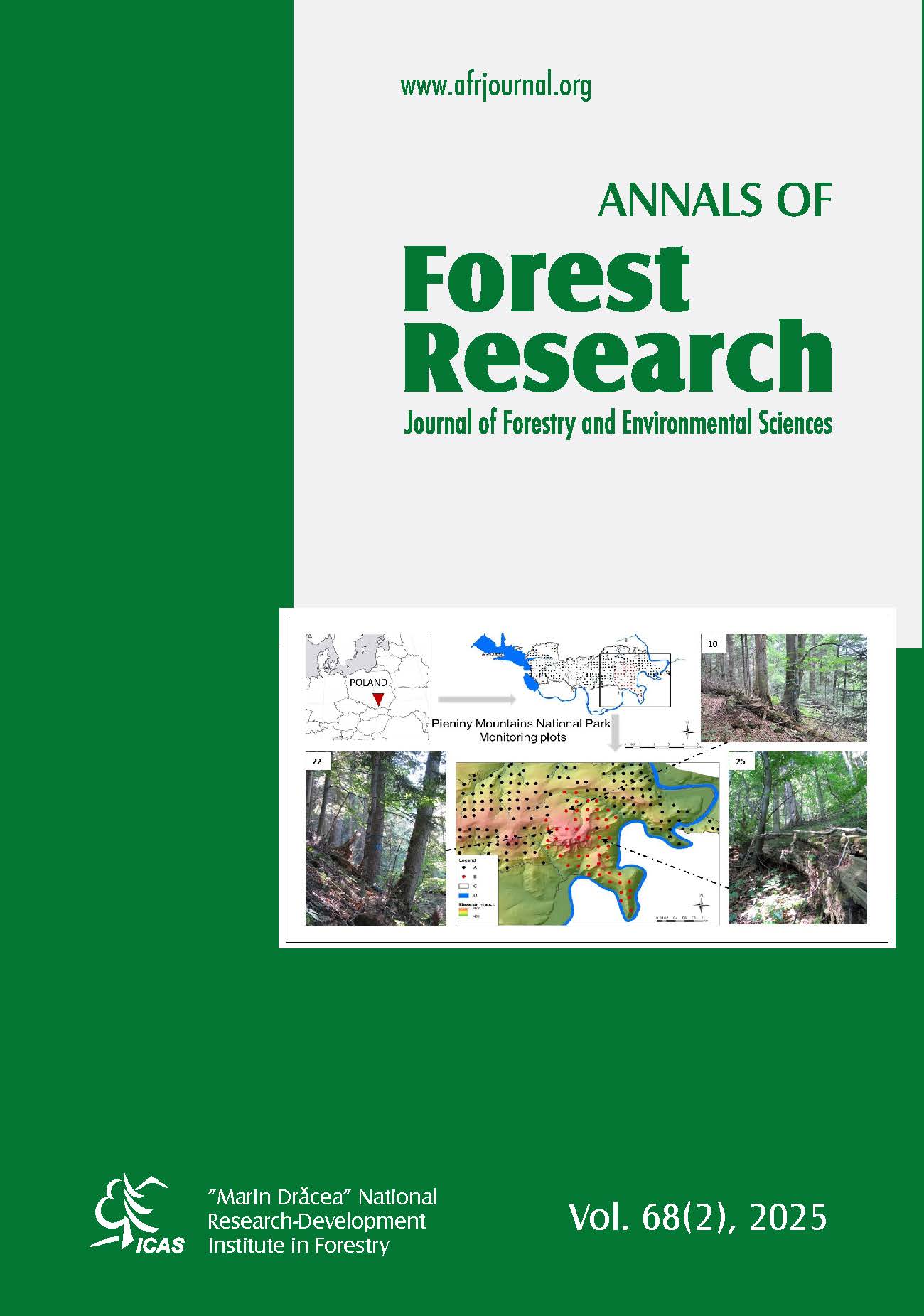
Virgin forests are considered valuable reference areas for studying forest ecosystem structures and functions as they have been naturally grown with no human interventions. In the Mediterranean region there are few such areas and even scarcer data on deadwood which is a key element for multi-functional forest management. Data regarding the amount and variety of standing and lying deadwood were recorded in the core zones of the Frakto virgin forest in the central Rodopi Mountains in eight square plots of 0.25 ha each. The average deadwood volume accounted for 175.71 m3 ha-1 with lying deadwood consisting mainly of conifers and representing over 60% of the total deadwood. The deadwood distribution showed a decreasing trend towards larger size classes while in terms of quality deadwood it was represented by all stages of decay, thus showing high variability. The research outcomes contribute to knowledge standards when adopting management regimes in mixed beech forests aiming at sustainable forest ecosystem management.
References
Badalamenti E., La Mantia T., La Mantia G., Cairone A., La Mela Veca D.S., 2017. Living and Dead Aboveground Biomass in Mediterranean Forests: Evidence of Old-Growth Traits in a Quercus pubescens Willd. s.l. Stand. Forests 8(6): 187. https://doi.org/10.3390/f8060187
Błoszyk J., Rutkowski T., Napierała A., Konwerski S., Zacharyasiewicz M., 2021. Dead Wood as an Element Enriching Biodiversity of Forest Ecosystems: A Case Study Based on Mites from the Suborder Uropodina (Acari: Parasitiformes). Diversity 13(10): 476. https://doi.org/10.3390/d13100476
Braga C.I., Crisan V.E., Petritan I.C., Scarlatescu V., Vasile D., Lazar G., Petritan A.M., 2023. Short-Term Effects of Anthropogenic Disturbances on Stand Structure, Soil Properties, and Vegetation Diversity in a Former Virgin Mixed Forest. Forests 14: 742. https:// doi.org/10.3390/f14040742
Brändli U.-B., Dowhanytsch J., 2003. Urwälder im Zentrum Europas. Ein Naturführer durch das Karpaten-Biosphärenreservat in der Ukraine. Birmensdorf, Eidg. Forschungsanstalt WSL; Rachiw, Karpaten-Biosphärenreservat. Bern, Stuttgart, Wien, Haupt. 192 pp.
Bujoczek L., Szewczyk J., Bujoczek M., 2018. Deadwood volume in strictly protected, natural, and primeval forests in Poland. European Journal of Forest Research 137: 401-418. https://doi.org/10.1007/s10342-018-1124-1
Castagneri D., Garbarino M., Berretti R., Motta R., 2010. Site and stand effects on coarse woody debris in montane mixed forests of Eastern Italian Alps. Forest Ecology and Management 260(9): 1592-1598. https://doi.org/10.1016/j.foreco.2010.08.008
Chivulescu Ș., Ciceu A., Leca Ș., Apostol B., Popescu O., Badea O., 2020. Development phases and structural characteristics of the Penteleu-Viforâta virgin forest in the Curvature Carpathians. iForest-Biogeosciences and Forestry 13(5): 389-395. https://doi.org/10.3832/ifor3094-013
Chivulescu Ș., Pitar D., Apostol B., Leca Ș., Badea O., 2022. Importance of Dead Wood in Virgin Forest Ecosystem Functioning in Southern Carpathians. Forests 13(3): 409 https://doi.org/10.3390/f13030409
Christensen M., Hahn K., Mountford E.P., Odor P., Standovár T., Rozenbergar D., Diaci J., Wijdeven S., Meyer P., Winter S., Vrska T., 2005. Dead wood in European beech (Fagus sylvatica) forest reserves. Forest Ecology and Management 210(1-3): 267-282. https://doi.org/10.1016/j.foreco.2005.02.032
D' Agostino R.B., Stephens M.A., 1986. Goodness-of-fit Techniques. Marcel Dekker, New York.
Delignette-Muller M. L., Dutang C., 2015. fitdistrplus: An R package for fitting distributions. Journal of Statistical Software 64(4): 1–34 https://doi.org/10.18637/jss.v064.i04
Diaci, J. (ed), 1999. Virgin Forests and Forest Reserves in Central and East European Countries. Proceedings of the Invited Lecturers’ reports presented at the COST E4 Management Committee and Working Group meeting in Ljubljana, Slovenia 25–28, April 1998. University of Ljubljana [includes country reports on Bosnia and Herzegovina, Croatia, Czech Republic, Poland, Romania, Slovenia and Switzerland]. 171 pp.
Diaci J., Rozenbergar D., Boncina A., 2010. Stand dynamics of Dinaric old-growth forest in Slovenia: are indirect human influences relevant? Plant Biosystems 144(1): 194–201. https://doi.org/10.1080/11263500903560785
Diaci J., Rozenbergar D., Anic I., Mikac S., Saniga M., Kucbel S., Visnjic C., Ballian. D., 2011. Structural dynamics and synchronous silver fir decline in mixed old-growth mountain forests in Eastern and Southeastern Europe. Forestry 84(5): 479–491. https://doi.org/10.1093/forestry/cpr030
Dittrich S., Jacob M., Bade C., Leuschner C., Hauck M., 2014 The significance of deadwood for total bryophyte, lichen, and vascular plant diversity in an old-growth spruce forest. Plant Ecology 215(10): 1123–1137. https://doi.org/10.1007/s11258-014-0371-6
Drama Forest District Office, 1974. Local Forest Tree Yield Tables, Ministry of Agriculture (in Greek)
Edwards D.M., Jay M., Jensen F.S., Lucas B., Marzano M., Montagné C., Peace A., Weiss G., 2012. Public preferences across Europe for different forest stand types as sites for recreation. Ecology and Society 17(1): 27-37. https://doi.org/10.5751/ES-04520-170127
Feller M.C., 2003. Coarse woody debris in the old growth forests of British Columbia. Environmental Reviews 11(1): 135–157. https://doi.org/10.1139/a03-008
Ficko A., Poljanec A., Boncina A., 2011. Do changes in spatial distribution, structure and abundance of silver fir (Abies alba Mill.) indicate its decline? Forest Ecology and Management 261(4): 844–854. https://doi.org/10.1016/j.foreco.2010.12.014
Firm D., Nagel T. A., Diaci J., 2009. Disturbance history and dynamics of an old-growth mixed species mountain forest in the Slovenian Alps. Forest Ecology and Management 257(9): 1893-1901. https://doi.org/10.1016/j.foreco.2008.09.034
Grigoriadis N., Petermann J., Schroeder E., Spyroglou G., 2012. Contribution to the assessment of the conservation status of spruce forests in Greece. Journal of Biological Research 17: 57-67.
Hahn K.,Christensen M., 2004. Dead wood in European Forest Reserves - A Reference for Forest Management. EFI-Proceedings 51:181-191.
Hamor F., Dovhanych Y., Pokynchereda V., Sukharyuk D., Bundzyak Y., Berkela Y., Voloshchuk M., Hodovanets B., Kabal M., 2008. Virgin forests of Transcarpathia. Inventory and management. Carpathian Biosphere Reserve, Royal Dutch Society for Nature Conservation, Rakhiv. 79 p.
Harmon M.E., Franklin J.F., Swanson F.J., Sollins P., Gregory S.V., Lattin J.D., Anderson N.H., Cline S.P., Aumen N.G, Sedell J.R., Lienkaemper G.W., Cromack K., Cummins K.W., 1986. Ecology of coarse woody debris in temperate ecosystems. Advances in Ecological Research 15:133–302.
Hochbichler E., O'Sullivan, A., van Hees A., Vandekerkhove K., 2000. WG2 Recommendations for Data Collection in Forest Reserves, with an Emphasis on Regeneration and Stand Structure. COST Action E4 Forest Reserve Research Network. Office for Official Publications of the European Communities, Luxembourg, 135-181.
Holeksa J., Zielonka T., Żywiec M., 2008. Modeling the decay of coarse woody debris in a subalpine Norway spruce forest of the West Carpathians, Poland. Canadian Journal of Forest Research 38(3): 415-428. https://doi.org/10.1139/X07-139
Holeksa J., Saniga M., Szwagrzyk J., Czerniak M., Staszyńska K., Kapusta P., 2009. A giant tree stand in the West Carpathians – An exception or a relic of formerly widespread mountain European forests? Forest Ecology and Management 257(7): 1577–1585. https://doi.org/10.1016/j.foreco.2009.01.008
Humphrey J.W., Sippola A.L., Lemperiere G., Dodelin B., Alexander K.N.A., Butler J.E., 2004. Deadwood as an indicator of biodiversity in European forests: from theory to operational guidance. EFI-Proceedings 5: 193-206.
Ionescu D.T., Hodor C.V., Petrițan I.C., Baltag E.Ș., 2024. The importance of standing deadwood in white-backed woodpecker (Dendrocopos leucotos) habitat from deciduous forests in central Romania. Annals of Forest Research 67(2): 121-134.
IPCC (Intergovernmental Panel on Climate Change), 2003. Good practice guidance for land use, land-use change and forestry. Institute for Global Environmental Strategies (IGES), Hayama, Japan.
Ježek K., 2004. Contribution of regeneration on dead wood to the spontaneous regeneration of a mountain forest. Journal of Forest Science 50(9): 405-414.
Kechagioglou S., Papadopoulou D., Tsitsoni T., 2022. Determining structure and volume of the European beech (Fagus sylvatica L.) deadwood in managed stands in the Rodopi Mountain Range National Park, Greece. Folia Oecologica 49(2):122-129. https://doi.org/10.2478/foecol-2022-0014
Kenderes K., Král K., Vrška T., Standovár T., 2009. Natural gap dynamics in a Central European mixed beech—spruce—fir old-growth forest. Ecoscience 16(1): 39-47. https://doi.org/10.2980/16-1-3178
Keren S., Diaci J., 2018. Comparing the quantity and structure of deadwood in selection managed and old-growth forests in South-East Europe. Forests 9(2): 76. https://doi.org/10.3390/f9020076
Körpel S., 1995. Die Urwälder der Westkarpaten. Gustav Fischer Verlag. Stuttgart, Jena, New York, 310 p.
Kraigher H., Jurc D., Kalan P., Kutnar L., Levanic T., Rupel M., Smolej I., 2002. Beech coarse woody debris characteristics in two virgin forest reserves in southern Slovenia. Forestry Wood Science Technology 69: 91-134.
Král K., Vrška T., Hort L., Adam D., Samonil P., 2010. Developmental phases in a temperate natural spruce–fir–beech forest: Determination by a supervised classification method. European Journal of Forest Research 129(3): 339–351. https://doi.org/10.1007/s10342-009-0340-0
Kucbel S., Saniga M., Jaloviar P., Vencurik J., 2012. Stand structure and temporal variability in old-growth beech-dominated forests of the northwestern Carpathians: a 40-years perspective. Forest Ecology and Management 264: 125–133. https://doi.org/10.1016/j.foreco.2011.10.011
Kupferschmidt A.D., Brang P., Schönenberger W., Bugmann H., 2003. Decay of Picea abies snags stands on steep mountain slopes. The Forestry Chronicle 79(2): 247-252. https://doi.org/10.5558/tfc79247-2
Laarmann D., Korjus H., Sims A., Stanturf J.A., Kiviste A., Koester K., 2009. Analysis of forest naturalness and tree mortality patterns in Estonia. Forest Ecology and Management 258: 5187-5195. https://doi.org/10.1016/j.foreco.2009.07.014
Lachat T., Bouget C., Bütler R., Müller J., 2013. Deadwood: quantitative and qualitative requirements for the conservation of saproxylic biodiversity. Integrative approaches as an opportunity for the conservation of forest biodiversity. In D. Kraus and F. Krumm (eds.), Integrative approaches as an opportunity for the conservation of forest biodiversity. European Forest Institute, Freiburg, pp. 92-102.
Leibundgut H., 1982. Europäische Urwälder der Bergstufe, dargestellt für Forstleute, Naturwissenschaftler und Freunde des Waldes. Paul Haupt Verlag, Bern/Stuttgart, 306 p.
Lombardi F., Cherubini P., Tognetti R., Cocozza C., Lasserre B., Marchetti M., 2013. Investigating biochemical processes to assess deadwood decay of beech and silver fir in Mediterranean mountain forests. Annals of Forest Science 70: 101–111. https://doi.org/10.1007/s13595-012-0230-3
Mansourian S., Rossi M., Vallauri D., 2013. Ancient Forests in the Northern Mediterranean: Neglected High Conservation Value Areas. WWF France, Marseille, 80 p.
Marra J. L., Edmonds R. L., 1994. Coarse woody debris and forest floor respiration in an old-growth coniferous forest on the Olympic Peninsula, Washington, USA. Canadian Journal of Forest Research 24(9): 1811-1817. https://doi.org/10.1139/x94-234
Maser C.M., Cline S.P., K. Cormack J.R., Trappe J.M., Hansen E., 1988. What we know about large trees that fall to the forest floor. In Maser C.M., Tarrant R.F., Trappe J.M., Franklin J.F. (eds.). From the forest to the sea: A story of fallen trees. USDA Forest Service. Gen. Tech. Rep. PNW-229, Portland, pp. 25-45.
Merganičová K., Merganič J., 2010. Coarse woody debris carbon stocks in natural spruce forests of Babia hora. Journal of Forest Science 56(9): 397-405. https://doi.org/10.17221/11/2010-jfs
Moreira-Arce D., Vergara P.M., Fierro A., Pincheira E., Crespin S.J., Alaniz A., Carvajal M.A., 2021. Standing dead trees as indicators of vertebrate diversity: Bringing continuity to the ecological role of senescent trees in austral temperate forests. Ecological Indicators 129: 107878. https://doi.org/10.1016/j.ecolind.2021.107878
Motta R., Berretti R., Lingua E., Piussi P., 2006. Coarse woody debris, forest structure and regeneration in the Valbona Forest Reserve, Paneveggio, Italian Alps. Forest Ecology and Management 235(1-3): 155-163. https://doi.org/10.1016/j.foreco.2006.08.007
Motta R., Berretti R., Castagneri D., Dukic V., Garbarino M., Govedar Z., Lingua E., Maunaga Z., Meloni F., 2011. Toward a definition of the range of variability of central European mixed Fagus-Abies-Picea forests: The nearly steady-state forest of Lom (Bosnia and Herzegovina). Canadian Journal of Forest Research 41(9): 1871–1884. https://doi.org/10.1139/x11-098
Motta R., Garbarino M., Berretti R., Meloni F., Vacchiano G., 2015. Development of old-growth characteristics in uneven-aged forests of the Italian Alps. European Journal of Forest Research 134: 19–31. https://doi.org/10.1007/s10342-014-0830-6
Motta R., Alberti G., Ascoli D., Berretti R., Bilic S., Bono A., Milic C., Vojislav D., Finsinger W., Garbarino M., Govedar Z., Keren S., Meloni F., Ruffinatto F., Nola P., 2024. Old-growth forests in the Dinaric Alps of Bosnia-Herzegovina and Montenegro: a continental hot-spot for research and biodiversity. Frontiers in Forests and Global Change 7:1371144. doi: 10.3389/ffgc.2024.1371144
Muller-Using S., Bartsch N., 2009. Decay dynamic of coarse and fine woody debris of a beech (Fagus sylvatica L.) forest in Central Germany. European Journal of Forest Research 128(3): 287–296. https://doi.org/10.1007/s10342-009-0264-8
Nagel T.A., Diaci J., 2006. Intermediate wind disturbance in an old-growth beech–fir forest in southeastern Slovenia. Canadian Journal of Forest Research 36(3): 629–638. https://doi.org/10.1139/x05-263
Ódor P., Standovár T., 2001. Richness of bryophyte vegetation in near-natural and managed beech stands: The effects of management-induced differences in dead wood. Ecological Bulletins 49: 219–229.
Oheimb G., Westphal C., Härdtle W., 2007. Diversity and spatio-temporal dynamics of dead wood in a temperate near-natural beech forest (Fagus sylvatica). European Journal of Forest Research 126: 359–370. https://doi.org/10.1007/s10342-006-0152-4
Orman O., Szewczyk J., 2015. European beech, silver fir, and Norway spruce differ in establishment, height growth, and mortality rates on coarse woody debris and forest floor—a study from a mixed beech forest in the Western Carpathians. Annals of Forest Science 72(7): 955–965. https://doi.org/10.1007/s13595-015-0492-7
Papadopoulou D., Raptis D., Kazana V., Tsitsoni T., 2023. Exploring Texture Diversity of Beech-Spruce-Fir Stands through Development Phase Analysis in the Frakto Virgin Forest of Greece. Diversity 15(2): 278. https://doi.org/10.3390/d15020278
Paletto A., Ferretti F., De Meo I., Cantiani P., Focacci M., 2012. Ecological and environmental role of deadwood in managed and unmanaged forests. In: Diez J.J (Ed.) Sustainable Forest Management–Current Research. InTech, pp. 219-238. https://doi.org/10.5772/24894
Paletto A., De Meo I., Cantiani P., Ferretti F., 2014. Effects of forest management on the amount of deadwood in Mediterranean oak ecosystems. Annals of Forest Science 71: 791-800. https://doi.org/10.1007/s13595-014-0377-1
Paluch J.G., 2007. The spatial pattern of a natural European beech (Fagus sylvatica L.)-silver fir (Abies alba Mill.) forest: a patchmosaic perspective. Forest Ecology and Management 253(1-3): 161–170. https://doi.org/10.1016/j.foreco.2007.07.013
Parisi F., Innangi M., Tognetti R., Lombardi F., Chirici G., Marchetti M., 2021. Forest stand structure and coarse woody debris determine the biodiversity of beetle communities in Mediterranean mountain beech forests. Global Ecology and Conservation 28: e01637. https://doi.org/10.1016/j.gecco.2021.e01637
Parviainen J., 2005. Virgin and natural forests in the temperate zone of Europe. Forest Snow and Landscape Research 79(1/2): 9–18.
Pastorella F., Avdagić A., Čabaravdić A., Mraković A., Osmanović M., Paletto A., 2016. Tourists’ perception of deadwood in mountain forests. Annals of Forest Research 59(2): 311-326. https://doi.org/10.15287/afr.2016.482
Pedlar J.H., Pearce J.L., Venier L.A., McKenney D.W., 2002. Coarse woody debris in relation to disturbance and forest type in boreal Canada. Forest Ecology and Management 158 (1-3):189–194. https://doi.org/10.1016/S0378-1127(00)00711-8
Peterken G.F., 1996. Natural woodland: Ecology and conservation in northern temperate regions. Cambridge University Press, Cambridge, 522 p.
Petritan I.C., Commarmot B., Hobi M.L., Petritan A.M., Bigler C., Abrudan I.V., Rigling A., 2015. Structural patterns of beech and silver fir suggest stability and resilience of the virgin forest Sinca in the Southern Carpathians, Romania. Forest Ecology and Management 356: 184–195. https://doi.org/10.1016/j.foreco.2015.07.015
Pregitzer K.S., Euskirchen E.S., 2004. Carbon cycling and storage in world forests: Biome patterns related to forest age. Global Change Biology 10(12): 2052–2077. http://doi.org/10.1111/j.1365-2486.2004.00866.x
Přívětivý T., Baldrian P., Šamonil P., Vrška T., 2017 Deadwood Density and Moisture Variation in a Natural Temperate Spruce-Fir-Beech Forest. Preprints. https://doi: 10.20944/preprints201705.0215.v1
Rahman M.M., Frank G., Ruprecht H., Vacik H., 2008. Structure of coarse woody debris in Lange-Leitn Natural Forest Reserve, Austria. Journal of Forest Science 54(4): 161-169. https://doi.org/10.17221/3102-JFS
Raptis, D. I., Kazana, V., Kazaklis, A., Stamatiou, C., 2020. Development and testing of volume models for Pinus nigra Arn., Fagus sylvatica L., and Quercus pubescens Willd. Southern Forests: a Journal of Forest Science 82(4): 331-341. https://doi.org/10.2989/20702620.2020.1733768
Raptis D.I., Kazana V., Kechagioglou S., Kazaklis A., Stamatiou C., Papadopoulou D., Tsitsoni T., 2022. Nonlinear Quantile Mixed-Effects Models for Prediction of the Maximum CrownWidth of Fagus sylvatica L., Pinus nigra Arn. and Pinus brutia Ten. Forests 13(4): 499. https://doi.org/10.3390/f13040499
Redolfi De Zan L., Rossi de Gasperis S., Fiore L., Battisti C., Carpaneto G. M., 2017. The importance of dead wood for hole-nesting birds: a two years study in three beech forests of central Italy. Israel Journal of Ecology and Evolution 63(1): 19-27. https://doi.org/10.1080/15659801.2016.1191168
Rozenbergar D., Konecnik K., Zaplotnik V., Diaci J., 2003. Stand structure, gap formation, and regeneration in virgin forest remnant Strmec—Slovenia. The NatMan Project. Working Report 17. p. 16.
Sabatini F.M., Burrascano S., Keeton W.S., Levers C., Lindner M., Pötzschner F. et al., 2018. Where are Europe’s last primary forests? Diversity and distributions 24(10): 1426-1439. https://doi.org/10.1111/ddi.12778
Šamonil P., Vrška T., 2007. Trends and cyclical changes in natural fir–beech forests at the north–western edge of the Carpathians. Folia Geobotanica 42: 337-361. https://doi.org/10.1007/BF02861699
Saniga M., Schütz J.P., 2001. Dynamics of changes in dead wood share in selected beech virgin forests in Slovakia within their development cycle. Journal of Forest Science 47: 557–565. https://doi.org/10.17221/11920-JFS.
Standovár T., Kenderes K., 2003. A review on natural stand dynamics in beechwoods of East Central Europe. Applied Ecology and Environmental Research 1(1-2): 19-46. https://doi.org/10.15666/aeer/01019046
Staniaszek-Kik M., Chmura D., Żarnowiec J., 2019 What factors influence colonization of lichens, liverworts, mosses and vascular plants on snags? Biologia 74: 375–384. https://doi.org/10.2478/s11756-019-00191-5
Stephens MA, 1979. Tests of fit for the logistic distribution based on the empirical distribution function. Biometrika 66 (3): 591-595. https://doi.org/10.1093/biomet/66.3.591
Stevens V., 1997. The ecological role of coarse woody debris: an overview of the ecological importance of CWD in BC forests. Working Paper 30. B.C. Ministry of Forests, Victoria, 16 p.
Stokland J.N., 2001. The coarse woody debris profile: an archive of recent forest history and an important biodiversity indicator. Ecological Bulletins 49: 71–83.
Spies T.A., Franklin J.F., 1988. Old-growth and forest dynamics in the Douglas-fir region of western Oregon and Washington. Natural Areas Journal 8(3):190–201.
Taylor S. L., MacLean D.A., 2007. Dead wood dynamics in declining balsam fir and spruce stands in New Brunswick, Canada. Canadian Journal of Forest Research 37(4): 750–762. https://doi.org/10.1139/X06-272
Višnjić C´., Solaković S., Mekić F., Balić B., Vojniković S., Dautbašić M., Gurda S., Ioras F., Ratnasingam J., Abrudan I.V., 2013. Comparison of Structure, Regeneration and Dead Wood in Virgin Forest Remnant and Managed Forest on Grmeč Mountain in Western Bosnia. Plant Biosystems 147(4):913-922 https://doi.org/10.1080/11263504.2012.751064
Winter S., Fischer H.S., Fischer A., 2010. Relative quantitative reference approach for naturalness assessments of forests. Forest Ecology and Management 259: 1624-1632. https://doi.org/10.1016/j.foreco.2010.01.040
Woodall C.W., Nagel L.M., 2006. Coarse woody type, a new method for analyzing coarse woody debris and forest change. Forest Ecology and Management 227 (1–2): 115–121. https://doi.org/10.1016/j.foreco.2006.02.032
Zielonka T., 2006. When does dead wood turn into a substrate for spruce replacement? Journal of Vegetation Science 17(6): 739-746. https://doi.org/10.1111/j.1654-1103.2006.tb02497.x
Downloads
Published
Issue
Section
License
All the papers published in Annals of Forest Research are available under an open access policy (Gratis Gold Open Access Licence), which guaranty the free (of taxes) and unlimited access, for anyone, to entire content of the all published articles. The users are free to "read, copy, distribute, print, search or refers to the full text of these articles", as long they mention the source.
The other materials (texts, images, graphical elements presented on the Website) are protected by copyright.
The journal exerts a permanent quality check, based on an established protocol for publishing the manuscripts. The potential article to be published are evaluated (peer-review) by members of the Editorial Board or other collaborators with competences on the paper topics. The publishing of manuscript is free of charge, all the costs being supported by Forest Research and Management Institute.
More details about Open Access:
Wikipedia: http://en.wikipedia.org/wiki/Open_access